Dearly Diary
What to Write in a Letter When You Don’t Know What to Say
The blank page is not a shortage of things to say. It is the pause before you choose one.
8 minute read · Letter-Writing Craft
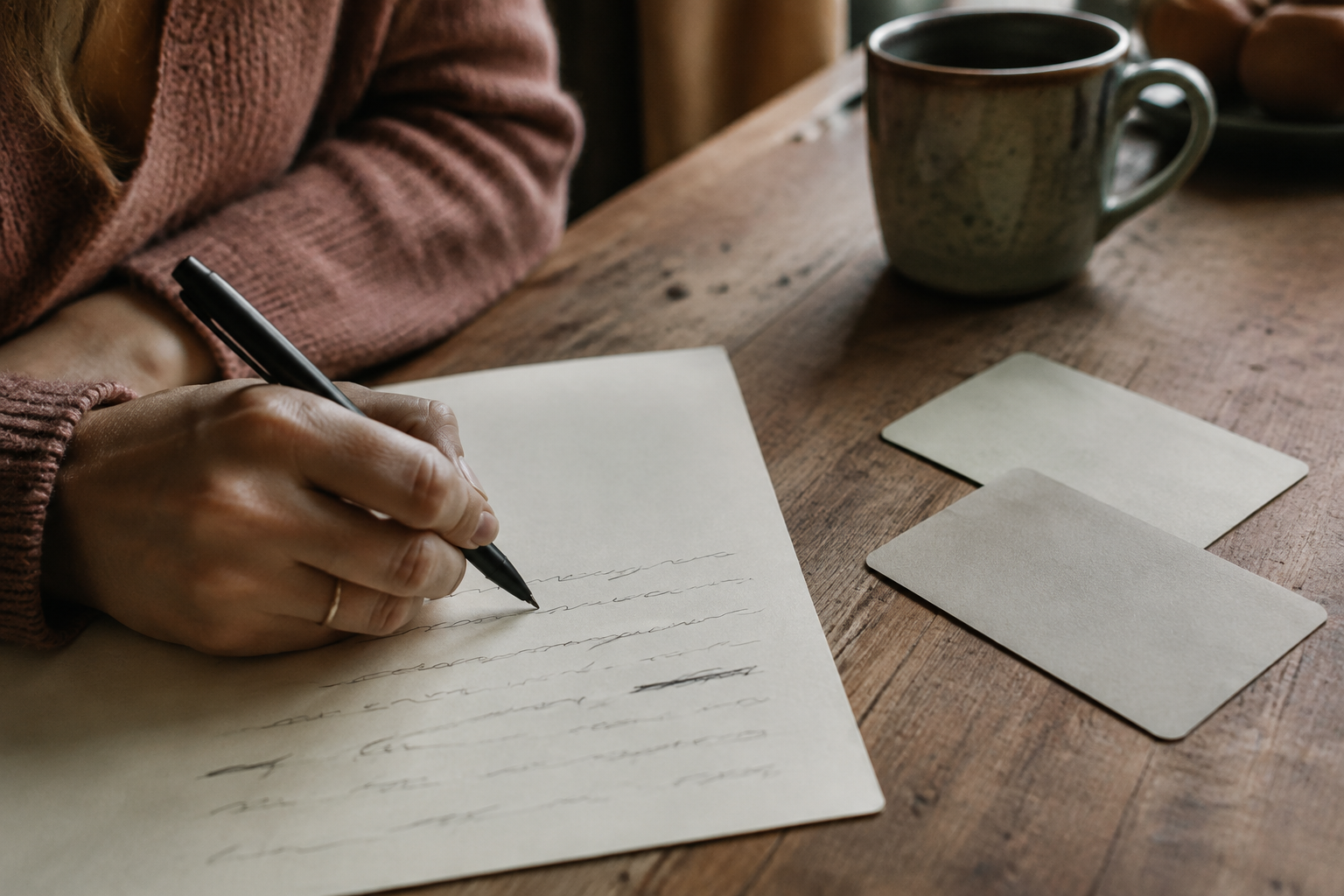
Almost everyone who sits down to write a letter has the same moment. The paper is out, the pen is good, the person is clearly in mind — and nothing comes. Not because there is nothing to say, but because a letter asks a question no message app ever asks: what, of everything, is worth writing down by hand?
The pressure is mostly imaginary. Nobody has ever opened an envelope hoping for a masterpiece. What people hope for, when they see their name in someone’s handwriting, is evidence that they were thought about for longer than a moment. Almost any honest sentence does that.
What follows is a set of places to start: openings that work, things worth writing about, what to say when the occasion is difficult, and how to finish without trailing off into “anyway, that’s all my news.”
Four Ways to Open a Letter
Say why you are writing
“I was making coffee this morning and thought of you, so I am writing before the thought escapes.” The reason can be that small. Naming it gives the letter a shape and gives the reader the pleasure of being the reason.
Start in the middle of something
Skip the throat-clearing and begin with whatever is actually in front of you: the weather doing something ridiculous, a queue you are standing in, the book open beside you. A letter that begins somewhere specific reads as though it came from a real afternoon.
Answer a question they never asked
“You once asked me whether I regretted moving. I have a better answer now.” Picking up an old thread tells the other person that the conversation never really ended for you.
Admit the blank page
“I have started this four times.” It is honest, it is disarming, and it is usually the first genuinely interesting line on the page. The letter has already begun.
What Is Actually Worth Writing About
Once the first paragraph exists, the rest is mostly a matter of choosing what to notice. Good letters are rarely about important events. They are about the texture of a life: what somebody ate, what they are avoiding, what made them laugh in a shop.
A useful test is whether a detail could belong to anybody. “Work has been busy” belongs to everybody. “I have started eating lunch in the car park because it is the only twenty minutes nobody can find me” belongs to one person. The second sentence is not more dramatic — it is simply yours.
Something small that happened this week
The overheard conversation, the neighbour’s new dog, the song that came on at exactly the wrong moment. Ordinary weeks make the best letters because they are the part of a life nobody else reports on.
What you have been reading, watching or listening to
Not a review — the bit that stayed with you, and why. Recommendations are one of the oldest forms of affection.
A memory the two of you share
Tell it in detail, including the parts they may remember differently. Half the pleasure of receiving it is the urge to write back and correct you.
Something you are looking forward to
Anticipation is generous material. It tells the reader what your next few months look like and gives them something to ask about.
Something you have changed your mind about
Opinions you have revised are far more interesting than opinions you hold. They also invite the same honesty back.
A question you actually want answered
One good question, placed near the end, is the single most reliable way to get a reply. Make it specific: not “how are you” but “are you still swimming in the mornings, and has it helped?”
Something you have never told them
Not a confession — just a corner of your life that has never come up. Most friendships have several, and letters are unusually good at reaching them.
What you appreciate about them
Say the specific thing: the advice that turned out to be right, the evening they stayed late, the way they are with their mother. People rarely hear the particular version, and they keep the page that says it.
If you would like a longer list to keep beside the paper, our free 36 Questions guide was made for exactly this moment, and the Diary essay on why those questions work explains how to ask better ones of your own.
What to Write to Particular People
To a new pen pal or a first letter
Aim for three things: who you are in ordinary terms, what your days look like, and one genuine question. Resist the urge to summarise your whole biography — you have many letters ahead, and mystery is part of the pleasure. If you want a longer version of this, the Diary has a whole essay on first letters.
To an old friend you have lost touch with
Do not apologise for the gap for more than one line. Guilt makes a letter hard to answer. Write as though the conversation paused rather than ended: “here is where I am now, here is what I wondered about you.”
To someone who is grieving
Do not try to make it better. Say the person’s name, say one true thing you remember about them, and say that you are thinking of the person reading. “I don’t know what to say, but I didn’t want to say nothing” is a complete and welcome letter.
To someone you love
Specifics, not adjectives. Not “you are wonderful” but the Tuesday they were wonderful and what they did. Love letters fail when they become general.
To someone far away
Write the things a video call flattens: the smell of the street, what the light does in the afternoon, the phrase you keep hearing locally. Distance is easier to carry when the other person can picture where you are standing.
To someone you are thanking
Name what they did, name what it changed, and stop. A thank-you letter that stays short and exact is remembered far longer than one that stretches for a page.
Four Things You Can Stop Worrying About
Your handwriting
Nobody keeps a letter because the letterforms were even. Legible is the entire standard, and even that is negotiable between people who know each other.
Length
A single honest paragraph posted this week beats four pages posted never. Short letters also make replying feel possible, which is how a correspondence survives.
Mistakes
Cross it out and carry on. A corrected line is proof of a person thinking; correction fluid is proof of an afternoon lost to perfectionism.
Being interesting enough
You are writing to somebody who chose to know you. They are not grading the material. They are reading your voice.
How to End a Letter
Endings are where most letters wobble. The trick is to stop doing news and do one of three things instead: ask the question you most want answered, name the next time you will be in touch, or say plainly what you hope for them.
“Write back and tell me about the garden.” “I’ll write again once the term ends.” “I hope this week is kinder than the last one was.” Any of those leaves the door open, which is the only job the last line has.
Then sign it however you actually feel. The distance between “best wishes” and “with love” is one of the few places a letter still lets you be brave.
The Smallest True Thing
If you take one thing from all of this: a letter does not need a subject. It needs a person, paid attention to, on an ordinary day. The blank page is not a shortage of things to say — it is only the pause before you choose one.
Choose the smallest true thing. Start there. The rest of the page tends to look after itself.
If the person you are writing to lives a long way off, the Diary has more on staying close to a long-distance friend and on the questions worth asking them. If you are also choosing something to send alongside the letter, there is a guide to gifts for writers and letter lovers and one for friends who live far away.
A gift from the Diary
36 Questions Worth Asking Someone You Want to Know Better
A free guide from Dearly, made to keep close. For first letters, long drives, old friends, and the conversations you wish lasted longer.
Wish you had someone to write to?
Dearly thoughtfully pairs people for handwritten correspondence, and carries the letters between them — no addresses exchanged.