Dearly Diary
Analog Hobbies That Help You Feel More Connected
Screen-free practices are addition, not subtraction \u2014 and nearly all of them end in company.
8 minute read · Slow Living
Most advice about screen time is subtraction. Delete the app, grey out the display, leave the phone in another room. It works for about four days, because nothing has taken the hour’s place.
Analog hobbies work better because they are addition. They occupy the hands, they run at their own speed, and — the part that matters most — nearly all of them end up involving other people. Not as an audience, which is what a screen offers, but as company.
These are the ones worth starting, and the reasons they leave you feeling closer to your own life rather than further from it.
Why Slow Practices Work
There is a shared quality to every practice below: a gap between doing the thing and seeing the result. The film goes to the lab. The bread proves overnight. The bulbs go in during October and do nothing until March. The letter takes four days to arrive.
That gap is not inefficiency. It is the part of the experience we have quietly removed from almost everything else, and it is where anticipation lives. A hobby with a waiting period gives you something to look forward to on an ordinary Wednesday, which turns out to be a significant portion of what people mean by feeling connected to their own life.
Ten Analog Hobbies Worth Keeping
Letter writing
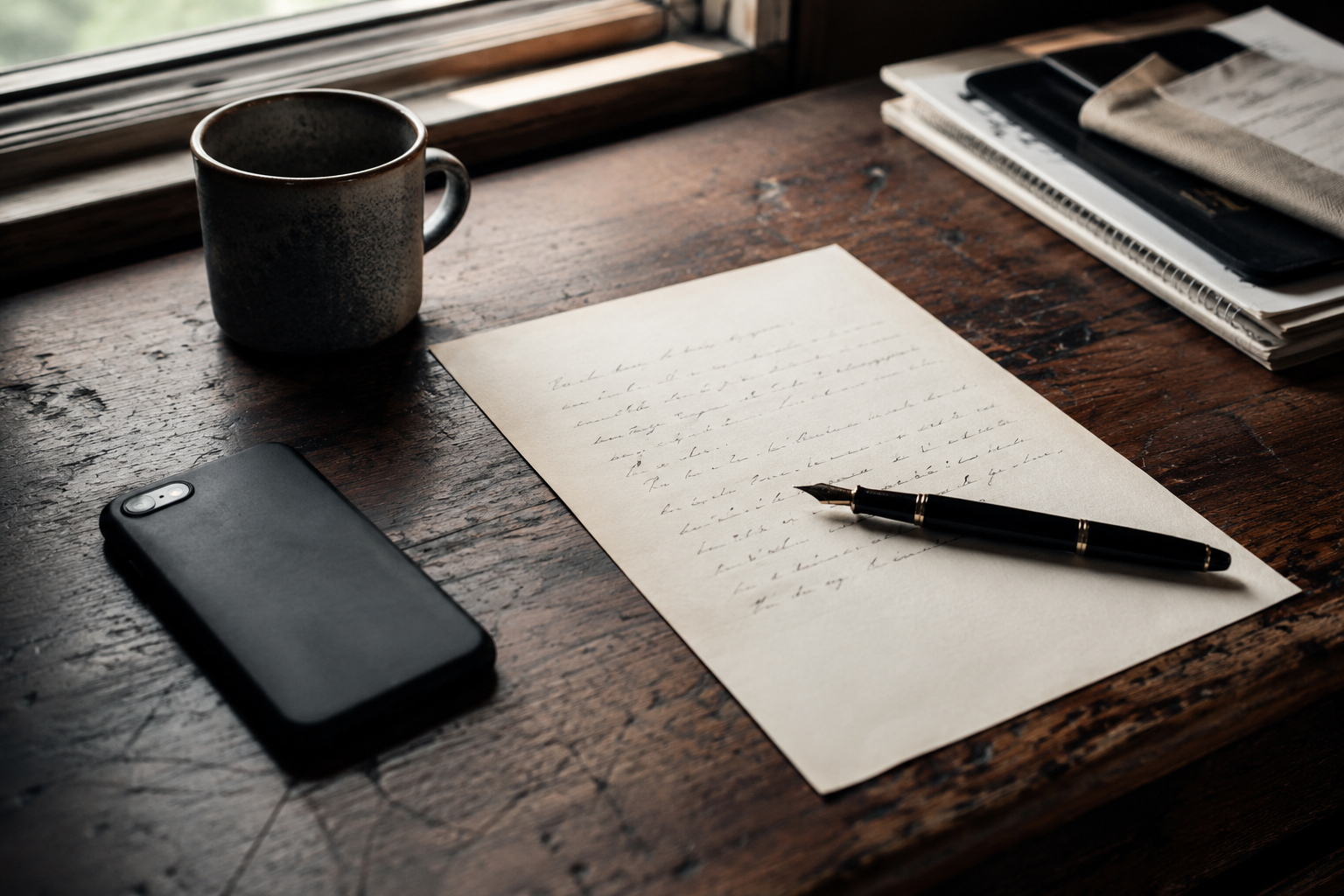
The most social analog hobby there is, and the cheapest to begin: paper, a stamp, one person. Unlike most practices on this list, it produces something in another person’s hands. It is also the only one where the reward arrives in the post with your name on it.
Film photography
Thirty-six frames, no preview, a week before you know what you got. It changes how you look at a room — you start composing rather than collecting. Second-hand cameras are cheap and community darkrooms exist in most cities.
Records, properly listened to
An album side is about twenty minutes, which is roughly the attention span we have all lost. The ritual — sleeve, needle, sitting down — is the whole point, and it makes music something you do rather than something playing behind something else.
Bread and slow cooking
A starter has to be fed. Dough has to be waited on. Cooking things that take two days rather than twenty minutes reintroduces a rhythm to a week, and it is nearly impossible to do without giving some of the result away.
Gardening, even on a windowsill
Nothing negotiates. You plant in autumn for spring, and the only way to speed it up is to stop wanting to. Gardeners are also relentlessly generous with cuttings, which is how a lot of people meet their neighbours.
Drawing and keeping a sketchbook
Not to be good at it. Drawing a thing for ten minutes is the most reliable method anyone has found for actually seeing it, and a sketchbook becomes a record of where you were standing in a way photographs never quite manage.
Mending and making clothes
Visible mending, darning, a sewing machine at the kitchen table. Repairing something rather than replacing it changes your relationship with the object, and these skills travel through families — somebody older than you almost certainly wants to teach you.
Board games and card nights
A standing game night is a friendship with an appointment attached, which is what adult friendships most often lack. Three hours at a table is also one of the few remaining settings where nobody checks a phone without being noticed.
Walking with a destination
Birdwatching, foraging, churches, coastlines, a slow map of your own city on foot. A purpose turns a walk from exercise into an interest, and it gives you something to write to someone about afterwards.
Keeping a journal by hand
Not productivity, not tracking. Half a page about the day, written in your own handwriting, which is a surprisingly good rehearsal for writing to somebody else. Most people who write letters well started by writing to themselves.

How to Actually Start One
Pick one, not four
Enthusiasm buys equipment for several hobbies and sustains none. One practice, kept for a season, will do more for you than four kits in a cupboard.
Buy second-hand and buy late
Almost everything here has a thriving used market, and the beginner version is genuinely good enough. Upgrade only once you know which part you love.
Give it a fixed hour
“When I have time” is the phrase that kills every analog hobby. Sunday morning, Tuesday after supper — a named slot survives, an intention does not.
Find the other people early
A club, a class, a correspondent, one friend doing it with you. Solitary practices drift. The ones with somebody attached last for years.
The One That Comes With a Person
Of everything on this list, handwritten correspondence is the one most often left off — probably because it does not look like a hobby. There is no equipment to photograph and no visible skill to acquire. It is simply paper, honesty, and somebody at the other end.
It also happens to be the only practice here that is built entirely around another person. The film is for you. The bread is mostly for you. A letter is not for you at all, and the pleasure comes from that — from having spent an hour on somebody’s Tuesday, and from the four-day wait that follows.
This article is published by Dearly, which pairs adults for exactly that kind of correspondence and carries the letters between them, so no addresses are exchanged. It is one way to begin. The other is a stamp and someone you already miss.
If you would like to begin on your own, the Diary covers what to write when the page feels blank and how to exchange letters without sharing your address.
Something to Hand Over
Analog hobbies are not nostalgia, and they are not a protest against anything. They are a practical answer to a modern complaint: that the days go quickly and leave very little behind.
Choose one that produces something — a print, a loaf, a page, a letter — and hand it to somebody. That is usually the part people were missing all along.
Most of these practices are easier with somebody alongside you, which is its own subject — the Diary covers making friends as an adult. Several of them also make excellent presents, which is the subject of our guide to gifts that aren’t more stuff.
Read Next
A gift from the Diary
36 Questions Worth Asking Someone You Want to Know Better
A free guide from Dearly, made to keep close. For first letters, long drives, old friends, and the conversations you wish lasted longer.
Wish you had someone to write to?
Dearly thoughtfully pairs people for handwritten correspondence, and carries the letters between them — no addresses exchanged.