Dearly Diary
Pen Pal Safety for Adults: How to Exchange Letters Without Sharing Your Home Address
Email needs an inbox. A letter needs a building. The practical ways adults keep the two apart.
9 minute read · Guides & Correspondence · Updated August 2026
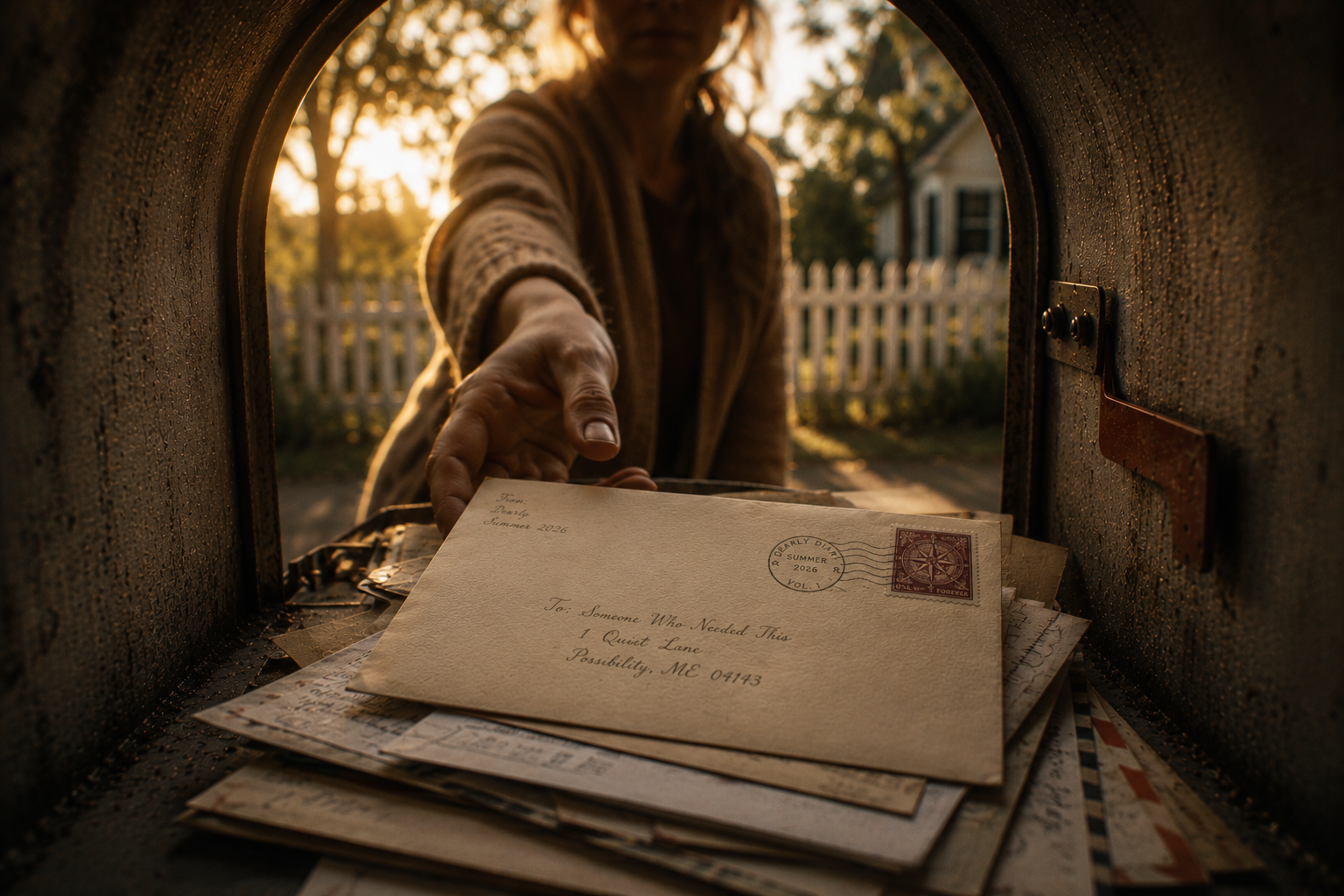
Every other kind of correspondence can be conducted from behind a screen name. Email needs an inbox. Messaging needs a handle. A letter needs a building — a real one, with a door, where you sleep.
That is the whole privacy problem with physical mail, and it is not a small one. It is also the reason a lot of adults who like the idea of a pen pal never quite start. The good news is that the problem has been solved several times over, in ways that are ordinary and unglamorous: boxes, forwarding, intermediaries. None of them require you to be paranoid, and none of them require you to hand your address to someone you met three weeks ago.
This guide is published by Dearly, a handwritten letter membership for adults. Dearly appears once, clearly labelled, near the end. The rest is about the options that have nothing to do with us.
The Short Answer: Five Ways to Receive Letters Privately
Adults can exchange handwritten letters without revealing a home address. Each of these trades cost, convenience and privacy differently — the right one depends on how often you want post and how much arranging you are willing to do.
- A PO box
- A numbered box at a post office. Letters arrive there instead of at your home, and you collect them. Predictable, widely available, and the most common answer to this question.
- A private or commercial mailbox
- A box rented from a mail-and-parcel business rather than the postal service. Often gives you a street-style address and longer opening hours, usually at a higher price.
- A mail-forwarding service
- Post is received at the service's address and passed on to you. Adds a layer between the sender and where you live, at the cost of a delay and a fee.
- A trusted intermediary
- A willing friend, relative, or workplace that agrees to receive your letters. Free, but it moves the privacy question onto someone else, so only do it with an explicit yes.
- A correspondence service that forwards between members
- A membership routes each letter between two people so neither address is exchanged at all. The least effort and the most structural privacy; also the only option here you pay for as a subscription.
Is It Safe to Give a Pen Pal Your Home Address?
There is no single answer, and anyone who gives you one is selling something. Plenty of long-running correspondences involve two people who know exactly where the other lives, exchange Christmas parcels, and have done for a decade. That is a perfectly normal outcome.
What is worth separating is the distinction between publishing an address and privately giving one. Posting your address on a public listing, a forum thread, or a social profile makes it available to everyone who reads that page — not only to the person you hoped would write. Giving it privately, to one named correspondent, after months of letters, is a different decision with a different risk, made by you rather than by a platform's default settings.
The other useful principle is that nothing about the beginning requires it. A first letter does not need your street. Trust in correspondence tends to build the way it builds anywhere else: slowly, through consistency, through small disclosures that are reciprocated rather than extracted. If someone needs your address in week one, that is information about them, not a requirement of the form.
No arrangement makes correspondence risk-free, and this guide does not claim otherwise. What the options below do is give you time — the ability to find out who someone is before deciding what they know about you.

The Options, Compared
01
A post office box
A box rented at a post office, with mail held there for you to collect. Availability, sizes, rental terms, identification requirements and fees are set by your postal service and change from time to time, so check the official source for your country rather than an article — in the United States that is USPS.
What works
- Your correspondent learns a box number, not where you live.
- Long-established and understood by everyone who handles mail.
- Usually the cheapest paid option, and rentable for short terms.
Worth considering
- You have to go and collect, which suits some routines and not others.
- Some senders and some services treat box addresses differently from street addresses.
- It protects your address, not your name — consider what else your letters reveal.
02
A private or commercial mailbox
A box rented from a private mail centre. In the United States these businesses are known as commercial mail receiving agencies; equivalents exist in most countries under different names. Terms, identification requirements and pricing are set by the individual business.
What works
- Often gives you a street-format address with a suite or unit number.
- Longer opening hours than many post offices, and staff who sign for things.
- Some will notify you when post arrives so you are not checking an empty box.
Worth considering
- Generally costs more than a postal box.
- Quality varies by operator; you are trusting a private company with your mail.
- If the business closes or moves, your address changes with it.
03
A mail-forwarding service
Letters are delivered to the service, which then forwards them on to wherever you actually are. Popular with people who travel, move often, or want a stable address that is not their home.
What works
- Your real address never appears on the envelope your correspondent sends.
- Works if you move, travel, or split time between places.
- Some services scan envelopes so you know what has arrived before it reaches you.
Worth considering
- Adds days to an already slow medium.
- Ongoing cost, sometimes per item as well as per month.
- The service itself knows both addresses, so read its privacy terms properly.
04
A trusted intermediary
Someone who has agreed — explicitly, not as a favour assumed — to receive letters on your behalf: a family member, a close friend, occasionally a workplace where personal post is permitted.
What works
- No cost, and no new company holding your details.
- Easy to set up and easy to stop.
- Useful as a temporary arrangement while you decide what you want longer term.
Worth considering
- It shares your privacy question with a third person who did not create it.
- Awkward if the correspondence becomes personal, or if it goes wrong.
- Workplaces change policies, and colleagues handle post.
05
A correspondence or matching service with forwarding
A membership that pairs you with a correspondent and passes letters between you, so that neither person writes the other's home address on an envelope. Address privacy is part of the design rather than something you arrange yourself.
What works
- Nothing to set up: there is no box to rent and no address to manage.
- Usually paired with private matching, so there is no public profile of you either.
- Members can still decide later to exchange details directly, if both want to.
Worth considering
- A subscription cost, and the service holds both addresses.
- You are inside one service's process rather than in charge of your own.
- Forwarding adds transit time on top of ordinary postal delays.
Postal rules differ by country and change over time. For United States boxes, the current terms are published by USPS. If you are still deciding where to look for a correspondent in the first place, the guide to finding a pen pal as an adult covers the places themselves.
Before Your First Letter: A Privacy Checklist
None of this needs to make correspondence feel like a security exercise. It is eight habits, most of which you only have to think about once.
Don't publish your address anywhere public
A listing, a forum post, a caption, a comment thread. Once an address is on a public page it is readable by everyone who finds that page, indefinitely, including people who were never going to write to you.
A first name or an initial is enough to begin
You can sign a letter however you like. Many correspondents use a first name only for the first few exchanges and add more when it feels right. Nobody reasonable will object.
Keep work out of the early letters
Employer name, office location, shift patterns and travel schedules together describe where you are and when you are not home. Write about what your work feels like rather than where it is.
Nothing financial, ever
Account details, card numbers, passwords, one-time codes, investment talk. No genuine correspondent needs any of it, and there is no version of a letter exchange that requires a password.
Check what your other profiles give away
If you have swapped social handles, remember that geotagged photos, a gym check-in or a visible street sign can locate you more precisely than an address would. Look at your own profiles the way a stranger would.
Say what you want from the exchange
Friendship or something open-ended, how often you can write, subjects you would rather leave alone. Stating expectations early is a privacy measure as much as a social one — it makes boundary-pushing visible when it happens.
If you ever meet, tell someone
A public place, in daylight, with your own transport, and one person in your life who knows where you are and when you expect to be back. Ordinary advice, worth following the first time regardless of how long you have written.
Never send money
The emergency, the stranded traveller, the medical bill, the gift card that would mean so much. However sympathetic the story and however many months of warmth precede it, a request for money in a correspondence is the point at which you stop.
Red Flags in a Correspondence
Any request for money or gift cards
The most common pattern by far, and usually preceded by weeks of attentive, affectionate letters. The affection is what makes the request work. It is not a reason to give it weight.
Pressure for identifying details
Full name, exact address, date of birth, workplace, the name of your bank — asked for early, asked for repeatedly, or asked for with a reason attached that does not quite make sense.
Boundaries treated as negotiable
You said you would rather not discuss something, or not write weekly, or not move to another platform. If a stated limit produces persuasion rather than acceptance, you have learned something important.
Intimacy that escalates far too fast
Declarations of love, talk of a shared future, or intense emotional dependence after very few letters. Genuine closeness in correspondence is slow; speed here is usually a technique rather than a feeling.
A story that keeps changing
Ages, jobs, locations, family members and timelines that do not hold still between letters. People misremember small things; identities that reshape themselves are a different matter.
Immediate pressure to move off a moderated platform
If you met through a service with reporting and moderation, an early push to abandon it — for direct mail, messaging or email — removes the only protections available to you. There is no hurry.
Threats, harassment, or guilt as leverage
Anger at a slow reply, guilt about not sharing more, anything threatening. This needs no analysis. Stop writing, and report it where reporting exists.
One flag is not proof of anything. People write clumsily, ask the wrong question, or come on stronger than they intended. What a flag earns is a slower pace and closer attention — and if two or three appear together, an ending.
Ending a correspondence requires no explanation and no final letter. Where a platform offers blocking or reporting, use it rather than managing the situation privately; that is what those tools exist for, and reports help the people who come after you.
When Might You Choose to Share Your Address?
Some correspondences do reach the point where exchanging addresses is the obvious next step — usually because two people want to send parcels, books, cuttings from a garden, or the sort of thing that does not travel well through an intermediary. There is nothing wrong with that, and plenty right about it.
The useful framing is that it is a choice, not an obligation. Nobody is owed your address. If a correspondent is content with a box number or a forwarding service for years, that is a complete arrangement, not a half-measure. And if you do decide to share, you can do it in stages: a city, then a box, then a street, at whatever pace you find comfortable.
If a correspondence eventually leads to meeting in person, the standard advice applies and is worth not skipping: somewhere public, in daylight, with your own way home, and someone in your life who knows the plan. Not because letter-writers are dangerous, but because it costs nothing and removes the only variable you can control.
How Dearly Handles Address Privacy
Dearly, which publishes this guide, is a curated handwritten letter membership for adults, and it is built around the fifth option described above. What follows is a description of how it currently works rather than a recommendation.
No public profiles to browse
Members complete a private profile and are introduced to one person. There is no directory, no browsing, and no profile of yours on display to anyone.
Letters are forwarded, not addressed directly
Correspondence travels through Dearly's forwarding process, so members do not write each other's home addresses on envelopes and a home address is not shared with a connection at the start.
What you share stays your decision
As a correspondence develops, members can choose what personal details to exchange, including whether to swap addresses directly. That choice belongs to the two people writing, not to Dearly.
A Welcome Kit and prompts
Membership begins with a Welcome Kit, and prompts are available for the weeks when the blank page feels intimidating.
What this does not mean: Dearly does not run background checks or verify anyone's identity, and forwarding is a privacy measure rather than a safety guarantee. Every judgement in this guide — about pace, about disclosure, about when to stop — still belongs to you inside a membership as much as outside one.
Dearly Membership is $49.99 per month, month to month. Cancel anytime.
The full picture sits on the Dearly snail mail club page, in how a membership works, and in the questions members ask most. If you are thinking of it for someone else, there is also Dearly as a gift.
Questions People Ask
Do pen pals need my home address?
No. A letter needs a delivery address, but it does not need to be the place you live. A PO box, a private or commercial mailbox, a mail-forwarding service, a trusted intermediary who has agreed to receive post, or a correspondence service that forwards letters between members will all deliver your mail without revealing where you live.
Can I use a PO box for pen pals?
Yes, and it is the most common solution. A post office box gives your correspondent a box number to write to instead of your street address, and you collect your letters yourself. Sizes, rental terms, identification requirements and fees are set by your postal service, so check its official information rather than relying on figures quoted in an article.
Can I send letters without giving someone my address?
Yes. Nothing obliges you to put a return address on an envelope, though without one a letter cannot be replied to directly. The workable version is to give a return address that is not your home — a box, a forwarding address, or a service that routes replies back to you — so the correspondence can continue while your home address stays private.
Is it safe to give an online pen pal my address?
It depends on the person and on how long you have known them, and no one can promise you an answer. There is an important difference between publishing an address publicly, where anyone can read it, and privately giving it to one correspondent after months of consistent letters. There is no need to share it early, and no obligation to share it at all.
What information should I avoid sharing with a new pen pal?
Early on, avoid your home address, your employer and work location, your regular schedule and travel dates, financial or account details, passwords and verification codes, and anything that pinpoints where you are at a given time. Ordinary life, opinions, interests and feelings are the material of a good letter and give away very little.
What should I do if a pen pal makes me uncomfortable?
Stop writing. You do not owe an explanation or a closing letter. If you met through a platform or a membership, use its reporting and blocking tools rather than handling it privately, and keep the letters in case they are needed. Requests for money, pressure for identifying details, or any threat are reasons to end a correspondence immediately.
Does Dearly share my home address?
No. Letters travel through Dearly's forwarding process, so a member's home address is not shared with their connection at the start and neither person writes the other's home address on an envelope. If two members later decide to exchange details directly, that is their choice to make.
Can pen pals eventually exchange addresses directly?
Yes, and many long-term correspondents do, usually when they want to send parcels or gifts that an intermediary cannot easily pass on. It should be a mutual decision made at a pace both people are comfortable with, and it is entirely reasonable to keep using a box or a forwarding service indefinitely instead.
The Part That Actually Matters
The point of all of this is not caution for its own sake. It is that a correspondence should be able to develop at the speed of two people getting to know each other, rather than at the speed of a form that demanded your address before the first letter.
Put something between the letters and your front door, write honestly, and let the rest arrive slowly. That is the whole method.
If you’d rather not manage an address at all
Dearly matches adults privately and forwards every letter, so home addresses are not exchanged unless two people later decide to.
Not ready to write yet? Read with us.
Quiet reflections on writing, waiting, and the people worth knowing slowly One letter a month. Never spam.
Read Next
A gift from the Diary
36 Questions Worth Asking Someone You Want to Know Better
A free guide from Dearly, made to keep close. For first letters, long drives, old friends, and the conversations you wish lasted longer.
Wish you had someone to write to?
Dearly thoughtfully pairs people for handwritten correspondence, and carries the letters between them — no addresses exchanged.